
Land transport in Oman: terminal to premises and GCC overland
Overview
The road leg is on the same file as the release
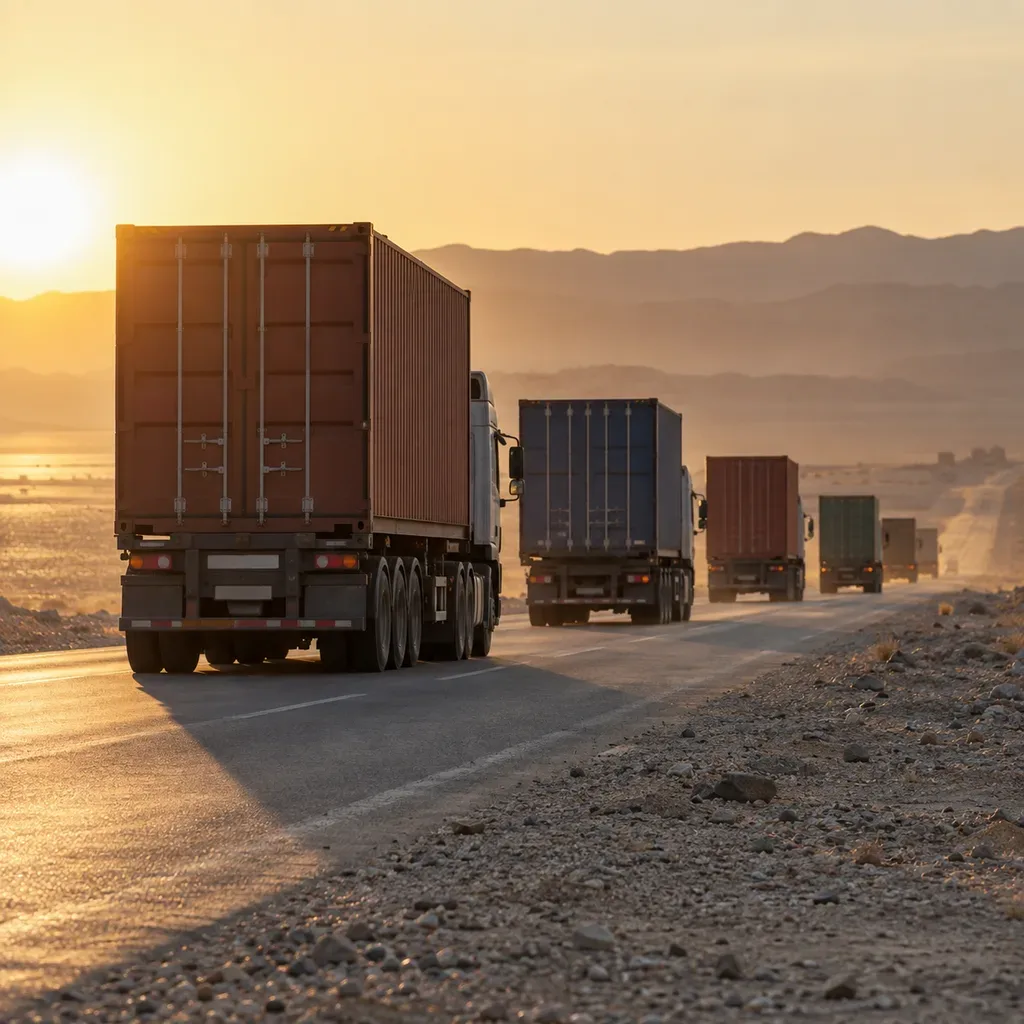
Ruby Shipping Line moves cargo inland: from the terminal at Sohar or Salalah to your premises, and onward across a GCC border by road. We do it with our own trucks and with contracted hauliers, and the movement sits on the same file as the booking and the customs entry.
The port gate was the one handover this office could not close. Every other seam was already inside one company. It is closed now, and a box can be attended at the berth, booked, cleared and delivered without the file leaving this office: the vessel, the cargo, the clearance and the road. That is port agency, the sea freight booking, customs clearance filed in house through Bayan, then a truck from the terminal to your door.
Whether a move runs on our own equipment or a contracted haulier's depends on the trailer, the destination and the timing. Either way the instruction leaves the file that holds your release.
Detention stops when the empty goes back, not when the goods come off
Three time charges run against an import and different parties collect them: storage from the port for occupying the yard, demurrage from the line for a container still inside the terminal after its free time, and detention from the line for a container that has left the terminal and not come back empty.
The last one is where importers lose money, because it does not stop where they think. Not at customs release, and not when the cargo is unloaded at your warehouse. It stops when the empty container is returned to the depot the line nominated, and the gate receipt from that depot is what the charge is settled against. An empty standing in your yard, or returned to a depot the line did not nominate, is an empty still on the clock.
So the empty return is planned with the delivery rather than after it: which depot, and how long the box stands at your premises while it is stripped. If the free time does not cover the standing time, saying so at the quote is cheaper than reading it on the invoice. It is a movement we perform ourselves, so we know when it was performed.
Where the days go between a release and a truck
An import usually stalls twice, and the second time is at the gate. Customs issues the release in Bayan. The delivery order comes from the carrier's agent, once the original bill of lading is surrendered or a telex release confirmed and local charges paid. Then somebody has to put a truck at the terminal, with the right paperwork, inside the window the terminal gives.
When the clearance sits in one company and the haulage in another, that window is where the day goes. The broker tells the importer, the importer tells the haulier, the haulier has nothing free until tomorrow, and both clocks run through the conversation. The truck is better ordered before the release than after it, and we are the ones ordering it, on the same file.
It also means we know what a truck is waiting on: with a query open on the entry, the truck is held rather than sent to stand outside the gate. Customs clearance covers the entry in more detail.
Terminal to premises inside Oman
A domestic move is priced on the cargo and the route: what it weighs, what trailer it needs, where it starts, where it ends, and what is waiting when the truck arrives. Cargo that is not in a container moves on the equipment it needs, break bulk on a flatbed and project pieces on a low bed.
The delivery address does more work than people expect. A container on a trailer needs room to turn and to stand, and a site that cannot take a 40ft trailer needs the load transferred to a smaller vehicle or the box stripped at a yard instead. Whether your own people are unloading, and whether they can do it inside the terminal's and the line's clocks, is better asked before the booking.
Sohar is where Oman's container and bulk cargo works, and it is our home port. Salalah is the transhipment hub on the Indian Ocean side, and a long haul from the north of the country is a routing decision and not only a rate.
Across a GCC border by road
Overland into the GCC is not a longer domestic trip. The goods travel under a customs transit procedure, which lets cargo leave a customs territory without being entered for home use where it landed. The transit is opened before the truck leaves and discharged where the goods arrive.
The GCC is a common customs territory, and that genuinely simplifies a border. What it does not do is remove the paperwork. At the border terminal the file is the transit declaration, the manifest, the commercial documents for the goods, and the vehicle's and the driver's own documents. Whether a movement needs more than that, a permit from an authority other than customs, or a certificate that had to be issued at origin, depends on the commodity and the destination, and it is asked before the goods are bought.
A truck stopped at a border is a truck, a driver and a trailer standing still somewhere nothing can be corrected locally, and a document that takes an hour to fix in Muscat takes a day from a border terminal. We prepare the transit file in the same office that files the entry.
What changes for a reefer on the road
A reefer is not a box with a label on it. It runs on power, and on the road that power comes from a generator set on the trailer, which means fuel and a unit that is checked rather than assumed. The temperature is set for the commodity, at the set point the line carried, not a number somebody rounds at the gate.
Two other things change. The line's free time on a reefer is shorter than on a dry box, so the detention arithmetic above is tighter. And a temperature excursion is a cargo claim rather than a delay, so the move is monitored and the record kept, because that record is what a claim is argued from months later.
Pre-cooling and the plug, at the terminal and at your premises, are worth settling before the vessel arrives. A reefer that reaches a site with nowhere to plug in runs its genset in your yard.
Out of gauge, and why the route is looked at before it is priced
Anything past the deck of a standard trailer is priced on three numbers and a map: the weight, the dimensions of the piece, and how those behave on the roads between the terminal and the site.
Over dimension and over weight movements need a permit, and a permit can carry conditions: escorts, a fixed route, and hours during which the load may move. A route survey is what makes the application honest. Bridge and cable heights, the width of turns and roundabouts, axle loads on the sections you will cross, and the last hundred metres into the site, which is where most of these plans fail.
That work happens before the price, not after it, which is why an out of gauge enquiry needs dimensions and a delivery address rather than a weight and a city.
Dangerous goods
Dangerous goods on the road need the class, the UN number and the packing group before anyone can quote, and a declaration that matches what is in the packages. Segregation, labels and placarding, and the requirements that fall on the vehicle and the driver, follow from the classification.
The classification that moved the cargo at sea does not automatically settle the road movement, and some commodities that travel inside a container as ordinary cargo are treated differently on a public road. Tell us at enquiry rather than at loading. The sea freight booking needs the same information, so it is usually on the file already.
What we need to quote a road move
- What it is: the commodity, and for dangerous goods the class and UN number.
- What it weighs, and its dimensions or piece count. For a container, the size and type, and whether it is loaded or empty.
- Where it starts and where it ends, with the delivery point as an address rather than a city, and what access it has.
- Whether the container is returning empty, and to which depot.
- Timing: the vessel's arrival or your own window, and whether the site can receive outside office hours.
- Who is unloading, and whether the site has the equipment.
For a cross border move, add the destination country and the consignee there, and say whether the goods have been entered in Oman or are moving in transit, because those are two different files. If you also want the sea leg booked or the entry filed, say so at the start and it stays one file.
We are young, and at sea we are still not the carrier
Ruby Shipping Line was registered in Muscat in 2025 and there is no history here to claim. We are not the cheapest and we do not have a global network. When another company is better placed for a particular movement we would rather say so than take the file.
The road work changes nothing about the sea leg. We are not the carrier there. We do not own or charter vessels, and a bill of lading issued through us belongs to a contracted principal and is signed by us as agent, so their terms, their time bar and the forum named in their bill govern any claim on it. What has changed is the gate, not the paper. More on the about page.
Tell us the cargo, the route and roughly when. Write to [email protected], call +968 9672 1075 to 1079, five lines, or WhatsApp +968 9367 4200. The office is open Sunday to Thursday, 08:00 to 17:00, and the reply comes from the person who will run the file.